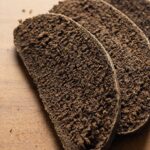
Easy Oil-Free Pumpernickel Bread
You are going to love this Easy Oil-free Pumpernickel bread recipe! It is simple, easy methods and is soft, moist with the perfect touch of sweetness!
Servings: 8 -10 slices
Ingredients
- 1 cup (120g) dark rye flour (I got mine here from Amazon)
- 2 cups (240g) regular all-purpose flour
- 2 tablespoons (14g) black cocoa powder (this helps give the beautiful dark color and rich flavor) got mine from Amazon
- 2 tablespoons (13g) golden ground flax
- 1 1/2 teaspoons instant yeast
- 1 1/4 teaspoons fine sea salt
- 3/4 cup + 2 tablespoons (210g) lukewarm water
- 3 tablespoons (60g) regular molasses, not blackstrap (SEE NOTES below)
NOTE
- The molasses gives a subtle sweetness to the bread, nothing overpowering. If you want your bread more sweet, then sub one of the tablespoons of molasses with syrup, but only 1, as the molasses helps to make the bread moist too.
NOTE
- I always recommend to use a scale for accuracy when baking, following MY gram weights listed, This is exactly how this recipe was tested, so follow my grams. Since we all measure differently, weighing ingredients is so important. This greatly improves your chance for success and lessons room for error. You never need cups or to compare them to the weights, just use the scale and bowl and make sure to zero out in between each ingredient.
- I use this scale.
Instructions
- Please refer to NOTES BELOW for baking tips. To a large bowl, combine the rye flour, all-purpose flour, black cocoa powder, flat, yeast and salt. Whisk well.
- In a separate bowl, combine the molasses and lukewarm water and whisk until smooth. Pour over the dry ingredients.
- Stir until it comes together in a rough, shaggy dough. It will seem too dry and in chunky pieces. Keep stirring for a few minutes.
- Then dump the dough out onto a clean surface and start kneading the dough to bring it all together. The more you knead it, you will notice it become moist all over.
- Knead for about 7 minutes or so until the dough is smooth and elastic.
- Form a round shape. Place the dough back into the large bowl (wipe it clean first if needed).
- Place a towel over the bowl and let it rest for 90 minutes until it puffs up. An oven with a light on or by a warm window works perfectly.
- This dough will NOT double in size like traditional bread, but it should be noticeably puffed up more. It is not a large boule.
- After the 90 minutes, lightly press any excess gas out of the dough if needed and reshape into a round boule shape.
- Place onto a lined sheet pan with parchment paper, cover again with the towel and let it rest another 90 minutes. It will puff up just a bit more at this step.
- Preheat the over at 400°F.
- I baked this bread scoring it and also a version not scoring it. Both turned out fabulous, so it's up to you. It does look more pretty and rustic with the slices on top, so I slightly preferred the look. If you score, just do 3 lines about 1/2 inch deep across the top of the bread.
- Bake for 30 minutes. It is ready once it feels hard and crusty on the outside and tapping it, it sounds heavy or hollow. It should be hard on the outside, but will be very soft on the inside.
- Let the bread cool minimum 1 hour. This is important, as if you cut it too soon it will be too dough in the center. Even after an hour, it will still be fairly warm and you can enjoy this heavenly bread plain or with some vegan butter or my vegan pumpkin cream cheese!
- This bread is best of course the first 2 days but is still good up to 3 days. Store at room temperature in a tight sealed container or wrapped towel so it doesn't dry out.
Notes
MOLASSES: Regular molasses is sweeter than blackstrap, which is extremely bitter. The pumpernickel bread won't really have any sweetness if you use blackstrap and may taste bitter, so I advise against it. You can find regular Grandma's brand molasses at most stores like many groceries and Target, Walmart, Kroger, etc.
CLIMATE: As we know, baking is scientific and different climates and atmospheres will affect moisture in doughs and baking times can vary. I can only vouch for how this bread turned out in my climate, Houston, Texas. I've made this bread 3 times and this exact recipe and baking time worked perfectly each time. Follow the directions as written and if after kneading the dough for several minutes it still seems too dry, add just a teaspoon of water at a time just until it comes together. It should be slightly tacky but easy to work with, not sticky. If it's too sticky or wet, then your bread will be too doughy when baked. I also did not need any extra flour on my surface to knead the dough, as the ratios were perfect.